
Risk management
Received a pentest report? How to execute a remediation plan
A pentest report identifies vulnerabilities, but reducing risk requires prioritizing findings, assigning owners, fixing issues and validating the results.
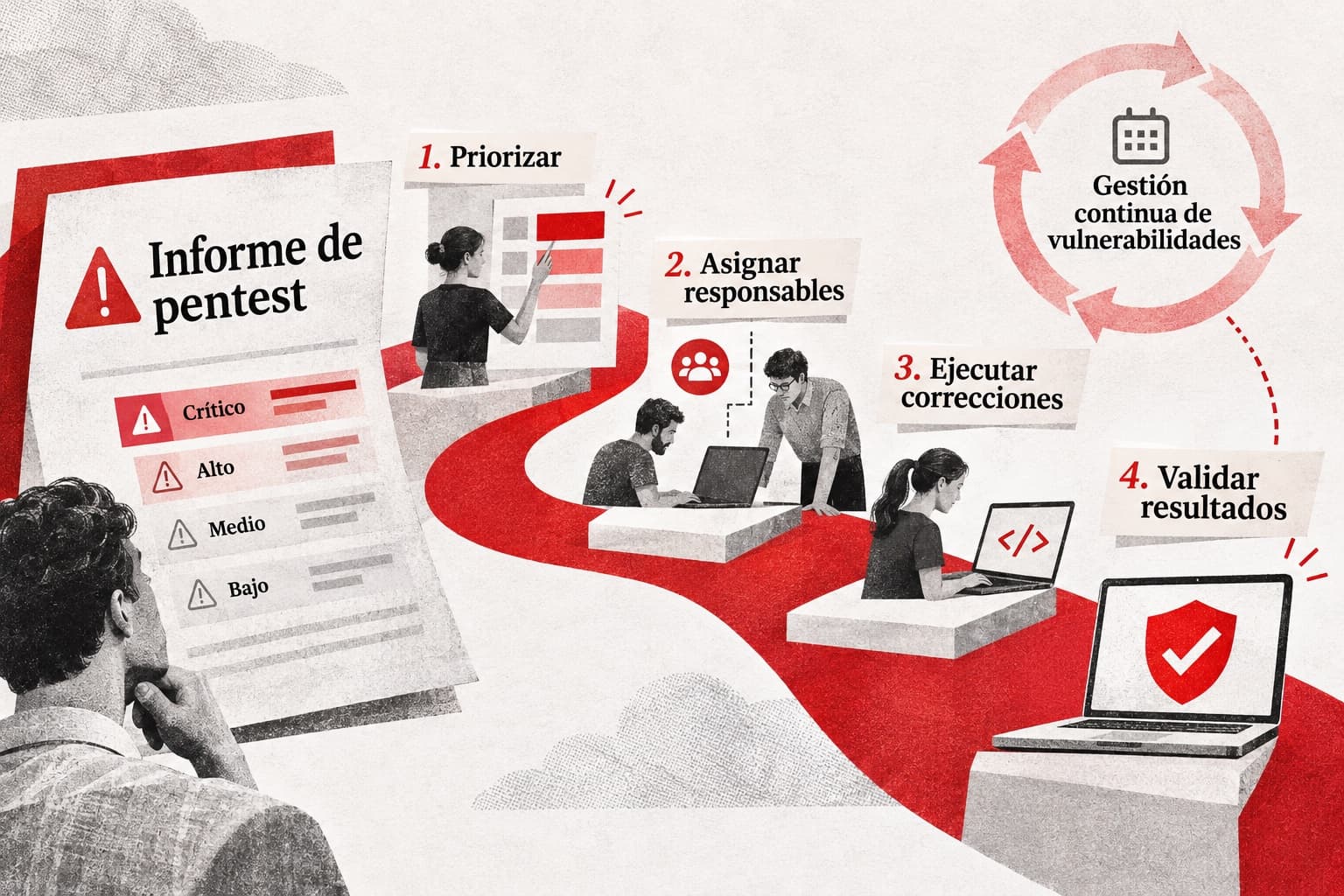
A penetration test report identifies vulnerabilities in a company's systems. Finding them does not mean they have been resolved. To reduce risk, the company needs to prioritize findings, assign owners, carry out fixes and confirm that those fixes actually work.
Receiving a pentest report is an important part of assessing a company's security. Penetration testing can uncover vulnerabilities in applications, infrastructure, networks or other systems that an attacker might exploit.
The challenge comes after the report arrives. A company may have a list of vulnerabilities ranked by severity, technical recommendations and evidence from the tests, but no clear plan for making the corrections.
At Talsoft, we believe the value of a penetration test should go beyond identifying problems. The next step is to turn the findings into a remediation plan that sets priorities, assigns owners and verifies that the improvements reduce the risks found.
Understand the findings before making fixes
One common mistake after a pentest is to try to fix every vulnerability at once or to prioritize solely by its technical severity. Findings are usually classified as critical, high, medium or low. That rating should also be considered alongside the company's context.
A vulnerability in an Internet-facing application that processes sensitive customer information is not the same as a similar issue in an internal system with restricted access. To set priorities, it helps to assess the system's exposure, the likelihood of exploitation and the potential business impact of an incident.
The aim is to direct resources first to the issues that present the greatest risk, without losing track of lower-severity findings that still need follow-up.
Turn the report into a remediation plan
Once priorities are clear, the pentest recommendations must become concrete actions. The report might call for updating a component, changing permissions, correcting a configuration or fixing vulnerable application code. For those recommendations to be carried out, they need to become part of a work plan.
One way to organize the work is a remediation plan that records:
- Each vulnerability identified.
- Its risk level.
- The actions needed to address it.
- The person responsible for those actions.
- The expected timeline.
This record makes it possible to track progress and see which issues have been resolved and which remain open.
 From a pentest report to fixes and validation
Assign owners and carry out the fixes
Remediation can involve several teams. Some vulnerabilities require work from Development, while others depend on IT, infrastructure, DevOps or technology vendors. Each finding should therefore have an owner who coordinates the required actions and tracks them through to resolution.
Fixes may involve software updates, configuration changes, permission reviews, code changes or additional controls.
It is also useful to look for common causes across findings. If several vulnerabilities stem from an insecure development practice or an unsuitable configuration, improving the underlying process can matter as much as resolving each issue individually.
Validate that the vulnerabilities have been fixed
Applying a fix does not necessarily mean the issue is resolved. An update might not reach every affected system, a configuration change may be insufficient, or a code change may not fully eliminate the vulnerability.
After carrying out the remediation actions, the company needs to check the results.
Validation may include reviewing configurations, evidence of updates, technical tests or a retest, which reassesses the findings to check whether they can still be exploited.
The company should also retain records of the fixes and their results. These records help demonstrate progress to auditors, customers or during compliance processes.
From a pentest to continuous vulnerability management
A pentest assesses particular systems at a point in time. Applications, configurations and exposure can all change afterward.
The company therefore needs a process for identifying new problems, reviewing open items and confirming that fixes remain effective.
At Talsoft, this approach forms part of our Annual Cybersecurity Maturity Program, through which we help companies identify their main risks, set priorities, implement improvements and continuously track their security controls.
If your company has received a pentest report and needs to move the fixes forward within a more structured program, contact us to discuss how we can help.
Frequently asked questions
How long does it take to fix vulnerabilities found in a pentest?
The time depends on the number and complexity of the findings, the affected systems and available resources. Some vulnerabilities can be fixed with simple configuration changes or updates, while others require code or infrastructure changes or coordination with vendors. The highest-risk findings should be assessed urgently.
Is it mandatory to fix every vulnerability in a pentest report?
Not every vulnerability needs the same response, but every finding should be assessed and have a documented decision. Some can be fixed immediately, others may need temporary measures, and certain situations may call for formal risk acceptance. Applicable contractual or regulatory requirements must also be considered.
Who should carry out a remediation plan?
Responsibility depends on the affected systems and the company's structure. Fixes may involve IT, Development, infrastructure, DevOps or external vendors. It is important to assign an owner to each finding and establish a way to track progress.
What is a retest, and when should it be performed?
A retest is a new technical evaluation to check whether vulnerabilities found in a pentest have been fixed. It makes sense after the improvements are in place and the systems are ready for validation. A retest is not necessarily the same as repeating the entire pentest.
How often should a company run a pentest?
Frequency depends on organizational risk, changes to systems, and regulatory or contractual requirements. In addition to periodic testing, new tests may be appropriate after significant changes to applications, infrastructure or services. A pentest should complement continuous vulnerability management.
Talsoft
Turn pentest findings into an actionable plan
Let's discuss how to prioritize fixes, assign owners and validate that the identified risks have been reduced.