
Step 1
We review context, external pressure, assets and available evidence.
Cybersecurity transformation for a growth-stage fintech in Australia/APAC: from scattered controls to an audit-ready operating model sustained by cadence, ownership and evidence.
Problem
The organization faced growing expectations from enterprise customers, audits and stakeholders. Controls existed, but they were not governed as a system: evidence was ad-hoc, operational visibility was limited and vulnerability follow-up lacked stable cadence.
Existing controls were scattered and lacked consistent ownership.
Evidence was difficult to sustain outside audit urgency.
Operational visibility was not sufficient for executive decisions.
Vulnerabilities lacked a stable prioritization, remediation and verification lifecycle.
Solution
The work used the Talsoft 6-level Maturity Framework as a decision and execution system: ISO-aligned governance, monthly/quarterly cadence, domain owners, minimum viable evidence and executive reporting based on risk and trends.
ISO-aligned ISMS governance and operating cadence.
Vulnerability management lifecycle: discover, prioritize, remediate and verify.
Awareness program with campaigns and tracking.
Incident response playbooks and readiness evidence.
Audit-ready evidence packs and executive dashboard.
Penetration Testing to validate exposure and prioritize remediation.
A public anonymized reference on moving from scattered controls to an operating model with ownership and evidence.
We review context, external pressure, assets and available evidence.
We identify gaps, risks and pending decisions.
We deliver prioritized next steps connected to the roadmap.
Repeatable operating model.
Ownership per control and domain.
30-60-90 and 3-6-12 improvement roadmap.
Evidence organized for audit and due diligence.
Risk and decision dashboard for leadership.
Exposure validation through PenTest.
Clearer decisions on what to do first.
Better conversations with customers and auditors.
Less dependence on isolated urgency.
More organized evidence.
Stronger alignment between business and IT.
A foundation for ongoing advisory support.
Business impact
An isolated cybersecurity service can produce a report. A maturity-connected service produces criteria, evidence and execution sequence.
Reduces ambiguity around priorities.
Exposes accepted or pending risks.
Prepares third-party conversations without improvisation.
Keeps progress moving after the deliverable.
Case signal
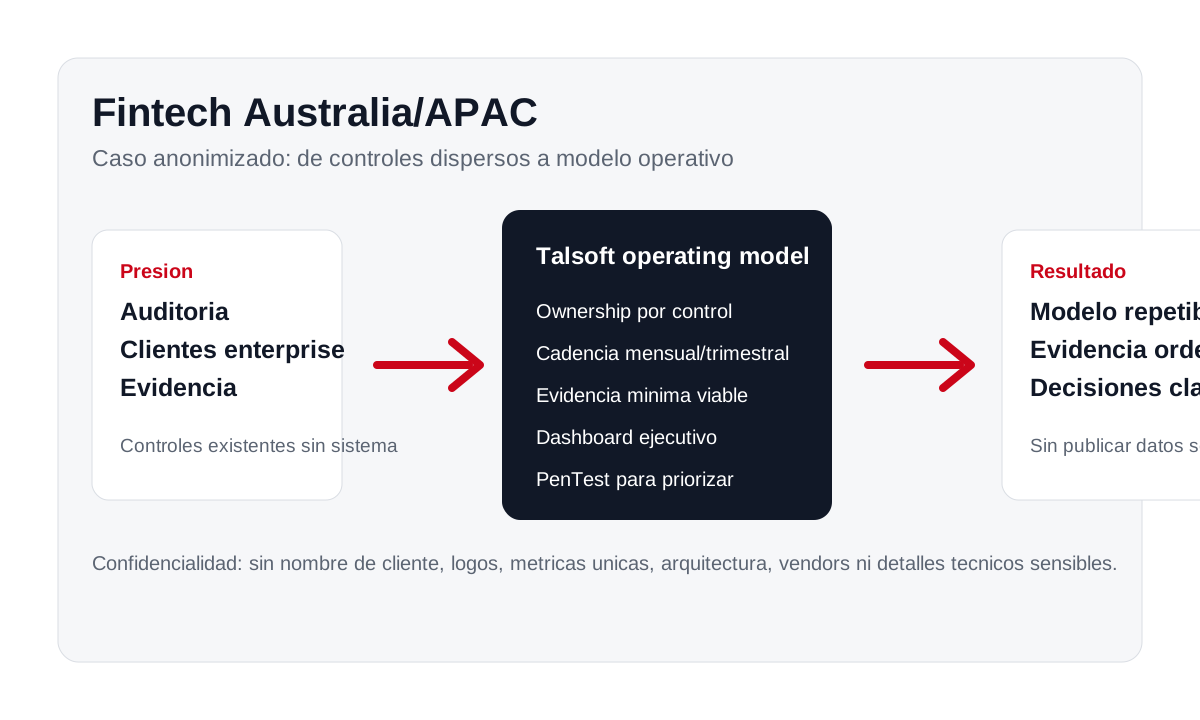
The central change was moving from isolated activities to an operation with cadence, ownership and evidence. Progress did not depend on internal heroes; it depended on a system that could be repeated month after month.
Public anonymized case. Names, logos, unique metrics, architecture, vendors and sensitive technical details are omitted.
Anonymized public visual
This visual summarizes the case without publishing client name, logos, unique metrics, architecture, vendors or sensitive technical details.
Published testimonials
Short references on professionalism, communication and support in cybersecurity work. Every project depends on its scope, context and objectives.
"Very professional service with immediate results."
"They got involved in solving the problem and showed strong availability to help."
"The action plan made the security audit useful and effective."
"Communication was fast and contacting Talsoft was easy."
No. It supports readiness, evidence and gap closure, but does not guarantee compliance or certification.
Yes, although Talsoft recommends connecting it to a roadmap so the result does not remain isolated.
Business context, current pressure, relevant assets, existing documentation and available owners.
The first step is not buying another tool. It is understanding which risk exists, which evidence is missing and what decision should be made now.