
Cybersecurity maturity
How to implement an ISMS
Implementing an ISMS means connecting risks, controls, owners, procedures and evidence in a system that can be managed and sustained over time.

Implementing an ISMS means connecting risks, controls, owners, procedures and evidence in a system that can be managed and sustained over time.
Many companies already have security controls implemented across different areas. They have backups, MFA, antivirus or EDR, access controls, policies, cloud tools, pentests or vulnerability management processes. The problem is that these initiatives often operate separately.
Technical controls may have no clear owner, policies may be disconnected from day-to-day operations, evidence may be scattered across different people, and processes may rely on one team member's knowledge. That is why implementing an ISMS means turning scattered initiatives into an organized, sustainable program.
At Talsoft, we approach this progressively. First, we assess the organization's current position; then, we define what needs improvement; we move into implementation; and finally, we work to ensure that the controls, processes, responsibilities and evidence put in place can be sustained over time.
First, understand the organization's starting point
Before implementing anything, you need to know where you stand. The first step is to understand the business, the systems and processes involved, and the main cybersecurity risks that could affect the company.
From there, you can review which controls already exist, which only work in part and which have not yet been implemented. At Talsoft, this review starts with an initial gap assessment that combines questions across different security areas with a review of evidence.
It is not enough to know whether a company says it has a particular control. You also need to understand how it is implemented and whether there is evidence to demonstrate it.
Prioritize according to risk
An assessment may reveal dozens of areas for improvement. Trying to address everything at once is rarely realistic. A central part of implementation is therefore connecting the gaps identified with the organization's most significant risks.
If a risk is likely and could have a major impact on the business, projects that address it should receive higher priority.
The ISMS then becomes a system for making decisions. A roadmap sets out initiatives for the coming months to define which projects should be addressed first and which can move forward later.
Turn the roadmap into concrete projects
Once priorities are set, implementation begins. The roadmap may include access management, backups and recovery, vulnerabilities, incident response, suppliers, training, policies, documentation or other issues identified during the assessment. The goal is to turn each significant gap into concrete, actionable work.
In some cases, this means implementing a technical control. In others, it means formalizing a partly established procedure, creating documentation and records, or setting up a way to track progress.
At Talsoft, the initial assessment provides input for this stage: projects identified during the gap assessment are prioritized and carried out according to the plan defined for each organization.
Assign owners and avoid dependence on one person
An ISMS also needs clear responsibilities. For each process, it helps to define who is accountable, who performs specific tasks, who should be consulted and who needs to be informed. This organizes internal work and reduces a common risk: a critical process depending entirely on one person's knowledge.
Alongside assigning owners, it may be necessary to create procedures and runbooks that explain how to perform specific tasks.
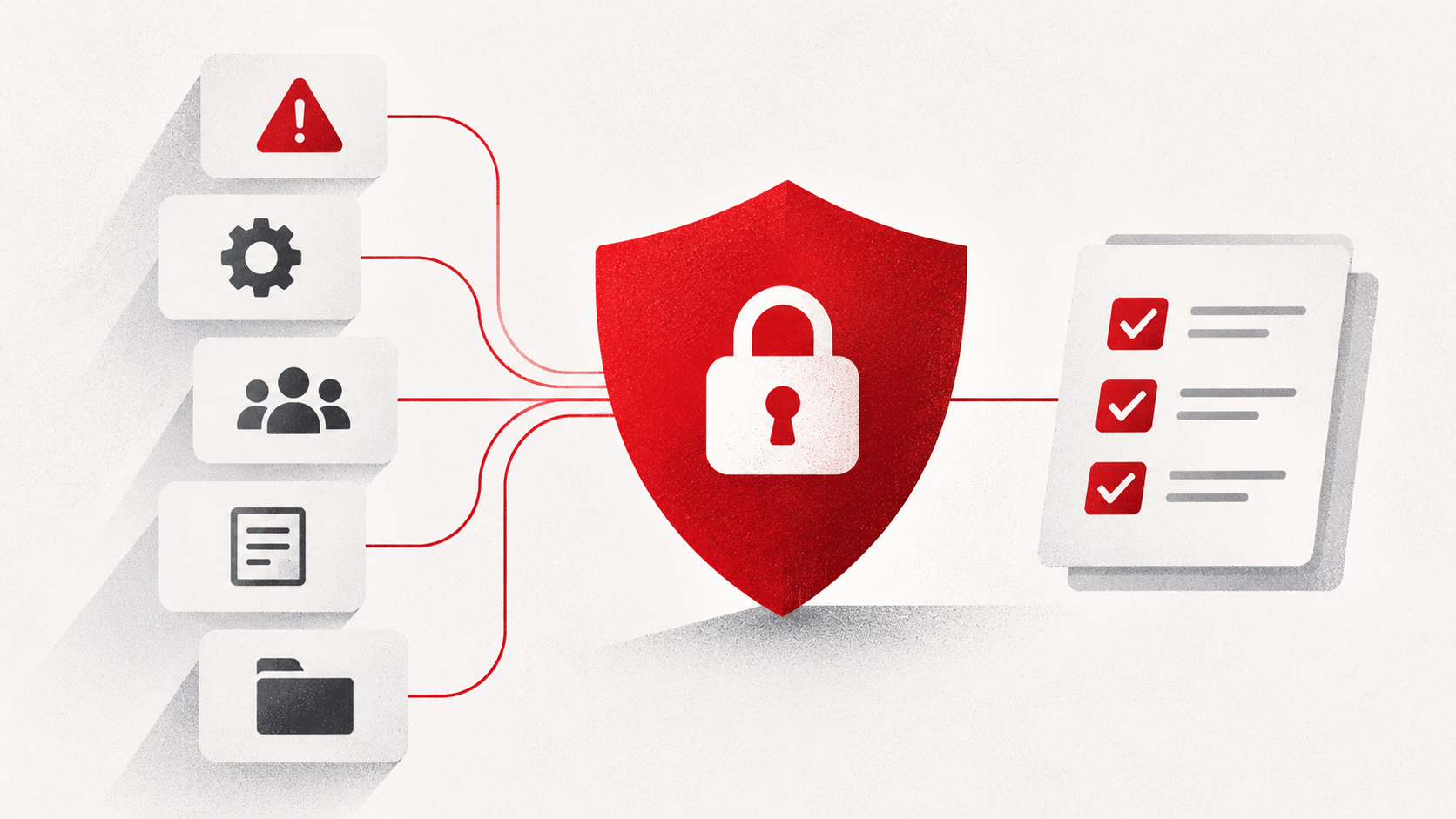 An ISMS connects risks, controls, owners and evidence within daily operations.
Build evidence into operations
Implementing a control once does not mean the process is complete. If a company reviews access, tests backups, manages vulnerabilities or trains employees, those activities should produce records that show they took place. Evidence can include reports, configurations, tickets, test results, review logs and other information produced by security processes.
This matters especially when an audit or a customer request for evidence arises. The goal, however, is not to start looking for evidence only when someone asks for it. Evidence should be generated and maintained as part of normal ISMS operations.
Measure and follow up
Once controls, processes and responsibilities are in place, one of the hardest stages begins: keeping them active. An ISMS needs follow-up mechanisms, such as regular records, metrics, KPIs, reviews of outstanding work and reports that show how the organization's security is evolving.
At Talsoft, this stage matters because it moves security beyond isolated projects and into continuous management.
Keep the ISMS alive
Implementing controls is only part of the process. The next challenge is sustaining them.
Documentation needs updates. Evidence must continue to be generated. Owners need to keep performing their tasks. Risks may change, and outstanding projects need to be revisited.
That is why an ISMS should not be treated as a project with an end date, but as a system that requires continuity.
If your company has several security initiatives but needs to organize them into a more structured program, explore Talsoft's Annual Cybersecurity Program and how we can help implement and evolve your ISMS.
Frequently asked questions
How long does it take to implement an ISMS in a company?
Implementing an ISMS may take between 3 and 12 months, depending on company size, operational complexity and the maturity of its security controls.
How much does it cost to implement an ISMS?
The cost depends on the project's scope, available resources and necessary improvements. It may include consulting, training, technology tools and external audits.
Is ISO 27001 certification required to implement an ISMS?
No. A company can implement an ISMS without seeking certification. ISO 27001 certification provides a way to demonstrate to third parties that its management system meets the requirements of the international standard.
Can an SMB implement an ISMS without its own cybersecurity team?
Yes. SMBs can implement an ISMS tailored to their needs by assigning internal owners and involving external specialists for selected tasks.
Which parts of a company should be included in an ISMS?
An ISMS can cover the whole organization or selected processes, services and departments. Its scope is defined according to risks, the information that needs protection and the business's objectives.
Talsoft
Organize your controls within an ISMS
Let's review the risks, owners and evidence you already have, and what to prioritize next.