
Risk management
How to prioritize cybersecurity risks without slowing the business
A practical method to turn technical findings into decisions, owners and next steps that leadership can sustain.
When everything looks urgent, organizations tend to choose between two extremes: addressing every finding at once or postponing decisions until more information is available. Neither approach creates sustainable improvement.
Priority does not come from technical severity alone. It also depends on the affected business process, actual exposure, ease of exploitation and the ability to detect or contain an incident.
Start with business context
Before sorting vulnerabilities, identify the systems that support critical operations, revenue, sensitive data or contractual commitments. A moderate issue on an exposed and essential asset may deserve attention before a critical vulnerability in an isolated environment.
Ask four questions for every risk:
- Which business asset or process is affected?
- What is the actual exposure and who could exploit it?
- What would be the impact of disruption, disclosure or fraud?
- Which existing controls reduce likelihood or impact?
Turn findings into decisions
A useful finding should lead to a concrete decision. The technical description matters, but it is not enough for execution. Every priority should include an owner, a target date, a verifiable action and the expected evidence.
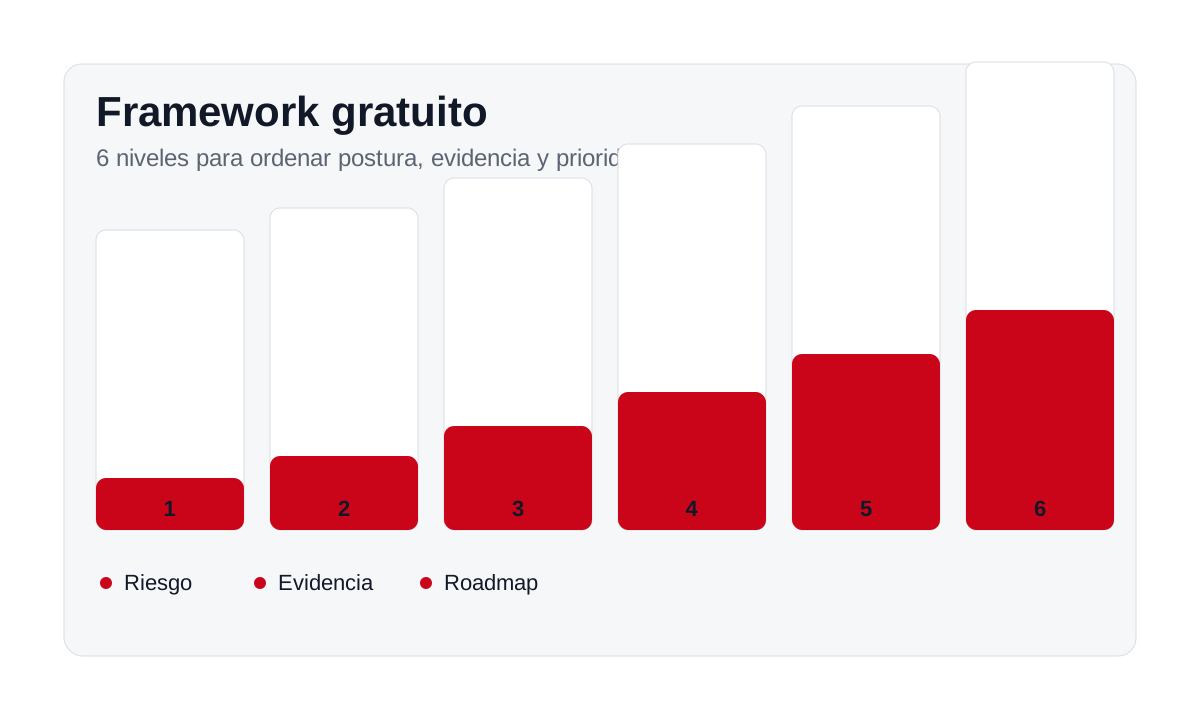 A shared framework helps organize priorities and evidence.
A minimum structure can look like this:
| Priority | Decision | Owner | Evidence |
|---|---|---|---|
| High | Reduce immediate exposure | Technology | Validated configuration |
| Medium | Improve detection and response | Security | Alerts and tested procedure |
| Planned | Strengthen governance | Leadership | Policy, owner and regular review |
Use realistic horizons
Separating the roadmap into horizons prevents urgent work from consuming all team capacity:
- 0 to 30 days: immediate exposure, critical access and high-likelihood risks.
- 31 to 90 days: repeatable controls, monitoring, tested backups and third-party management.
- Beyond 90 days: structural initiatives, architecture, governance and maturity.
The goal is not to produce a perfect list. It is to maintain a defensible sequence that can be reviewed when the business, threats or available resources change.
Evidence closes the loop
Marking a task complete does not prove that risk decreased. Validation may include a new technical test, a configuration capture, an automated report or a documented exercise.
When priorities, owners and evidence live in the same tracking system, cybersecurity stops being a collection of initiatives and starts operating as a managed program.
When the company needs to sustain this method beyond a point-in-time assessment, the next step is understanding what a Cybersecurity Maturity Partner is and how this role connects risks, controls, owners and evidence through a continuous roadmap.
Talsoft
Turn your priority risks into a clear next step
Let's review the context and decide whether GAP, PenTest, readiness or an improvement roadmap is the right move.